
大家好,欢迎来到IT知识分享网。
文章目录
说明
day69-70 矩阵分界
(如有问题,欢迎指正~)
1.基于矩阵分解的推荐系统(Funk-SVD算法)
基于矩阵分解的推荐系统的算法有许多,如SVD,Funk-SVD,NMF等,而结合今天的文章主要学习的是Funk-SVD算法(一种基于随机梯度下降的简化的SVD算法,通过学习用户特征和项目特征来预测评分)
基于用户-项目评分矩阵,捕捉用户和项目之间的隐含关系,通过将矩阵分解用户特征矩阵和项目特征矩阵的乘积来进行预测,如:矩阵 m ∗ n m*n m∗n 可以分解为: m ∗ k 与 k ∗ n m*k 与k*n m∗k与k∗n
例如下,假设我们特征隐含因子k就选2:
| 用户 | 电影1 | 电影2 | 电影3 | 电影4 |
|---|---|---|---|---|
| user1 | 5 | 4 | – | 2 |
| user2 | – | 2 | 4 | – |
| user3 | 3 | – | – | 1 |
| user4 | – | 5 | 2 | 3 |
所以呀,我们将矩阵进行分解,从中提取出用户和项目的隐藏特征,并利用这些特征进行推荐。分解为两个矩阵:用户特征矩阵表示用户在隐藏特征空间中的偏好,而项目特征矩阵表示项目在隐藏特征空间中的属性。原始矩阵: m ∗ n m*n m∗n, 用户矩阵: m ∗ k m*k m∗k; 项目特征矩阵: n ∗ k n*k n∗k(做了转置)
例如:
下面有4个用户对4部电影评分,其中满分为5分,-表示未进行评分,
| 用户 | 电影1 | 电影2 | 电影3 | 电影4 |
|---|---|---|---|---|
| user1 | 5 | 4 | – | 2 |
| user2 | – | 2 | 4 | – |
| user3 | 3 | – | – | 1 |
| user4 | – | 5 | 2 | 3 |
我们通过分解,分界为两个矩阵:用户特征矩阵和项目特征矩阵。
用户特征矩阵
| 用户 | 特征1 | 特征2 |
|---|---|---|
| user1 | 0.8 | 0.6 |
| user2 | 0.4 | 0.9 |
| user3 | 0.6 | 0.3 |
| user4 | 0.7 | 0.5 |
项目特征矩阵
| 项目 | 特征1 | 特征2 |
|---|---|---|
| 电影1 | 0.9 | 0.5 |
| 电影2 | 0.3 | 0.8 |
| 电影3 | 0.6 | 0.2 |
| 电影4 | 0.7 | 0.6 |
2.随机梯度下降(SGD)
通过一些基础知识的回顾去理解什么是随机梯度下降,导数 -> 偏导数 -> 方向导数 -> 梯度-> 随机梯度下降
2.1 导数
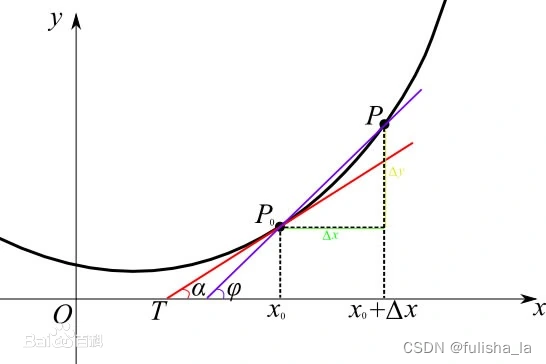
函数在这一点附近的变化率,切线的斜率,函数 y = f ( x ) y=f(x) y=f(x)在点 x 0 x_{0} x0处的导数: lim Δ x → 0 Δ x Δ y = lim Δ x → 0 f ( x 0 + Δ x ) − f ( x 0 ) Δ x \lim_{\Delta x \to 0}\frac{\Delta x}{\Delta y}=\lim_{\Delta x \to 0}\frac{f(x_{0} +\Delta x) – f(x_{0})}{\Delta x} Δx→0limΔyΔx=Δx→0limΔxf(x0+Δx)−f(x0)
2.2 偏导数
2.3 方向导数
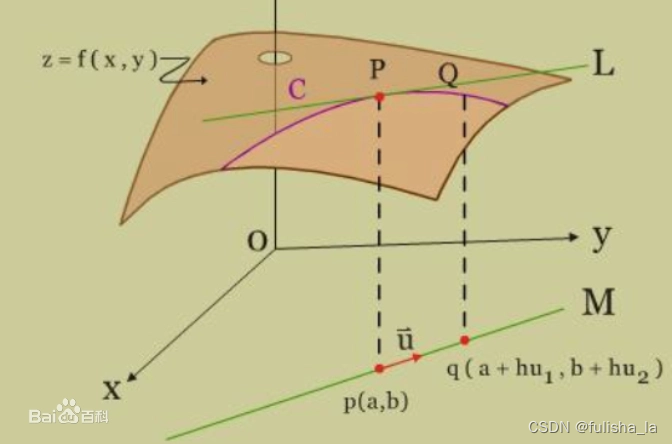
在函数定义域的内点对某一方向求导得到的导数,一般为二元函数和三元函数的方向导数。方向导数可分为沿直线方向和沿曲线方向的方向导数。相比于偏导数,他能沿任意方向(函数沿着某个特定方向的变化速率) cos α , cos β \cos \alpha, \cos \beta cosα,cosβ为L方向余弦
∂ f ∂ l ∣ ( x 0 , y 0 ) = f x ( x 0 , y 0 ) cos α + f y ( x 0 , y 0 ) cos β \frac{\partial f}{\partial l}|(x_{0}, y_{0})=f_{x}(x_{0}, y_{0})\cos \alpha + f_{y}(x_{0}, y_{0})\cos \beta ∂l∂f∣(x0,y0)=fx(x0,y0)cosα+fy(x0,y0)cosβ
2.4 梯度
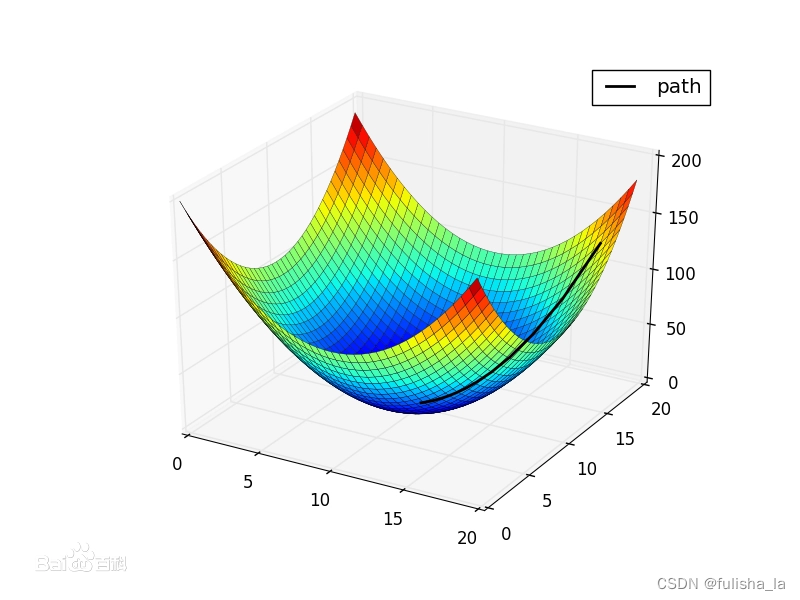
∂ f ∂ l ∣ ( x 0 , y 0 ) = f x ( x 0 , y 0 ) cos α + f y ( x 0 , y 0 ) cos β = g r a d f ( x 0 , y 0 ) e i ⃗ = ∣ g r a d f ( x 0 , y 0 ) ∣ cos θ \frac{\partial f}{\partial l}|(x_{0}, y_{0})=f_{x}(x_{0}, y_{0})\cos \alpha + f_{y}(x_{0}, y_{0})\cos \beta =gradf(x_{0},y_{0})\vec{e_{i}}=|gradf(x_{0}, y_{0}) |\cos\theta ∂l∂f∣(x0,y0)=fx(x0,y0)cosα+fy(x0,y0)cosβ=gradf(x0,y0)ei=∣gradf(x0,y0)∣cosθ
2.5 随机梯度下降,与损失函数之间的关系
总结:
- 导数:函数在某点附近的变化率,是一个数值。
- 偏导数:函数某点沿一个某一个维度的变化率,是一个数值。
- 方向导数:函数某点沿一个某一个方向的变化率,是一个数值.
- 梯度:函数某点变化率最大的方向,是一个向量
- 梯度下降
沿着梯度下降的方向求解极小值,(梯度上升:沿着梯度上升的方向可以求得极大值)梯度下降的基本思想是通过迭代的方式逐步更新模型的参数,使损失函数的值逐渐减小,最终达到局部最优或全局最优的参数值。其中随机梯度下降每次迭代只使用一个样本或一小批样本来计算梯度,并根据该梯度来更新参数(与批量梯度下降有所区别)
3.代码理解
/ * @param args */ public static void main(String args[]) { testTrainingTesting("C:/Users/fls/Desktop/Desktopmovielens-943u1682m (2).txt", 943, 1682, 10000, 1, 5, 2000); }// Of main 其中
/ * Compute the MAE. * @return MAE of the current factorization. */ public static void testTrainingTesting(String paraFilename, int paraNumUsers, int paraNumItems, int paraNumRatings, double paraRatingLowerBound, double paraRatingUpperBound, int paraRounds) { try { // Step 1. read the training and testing data MatrixFactorization tempMF = new MatrixFactorization(paraFilename, paraNumUsers, paraNumItems, paraNumRatings, paraRatingLowerBound, paraRatingUpperBound); tempMF.setParameters(5, 0.0001, 0.005); // Step 3. update and predict System.out.println("Begin Training ! ! !"); tempMF.train(paraRounds); double tempMAE = tempMF.mae(); double tempRSME = tempMF.rsme(); System.out.println("Finally, MAE = " + tempMAE + ", RSME = " + tempRSME); } catch (Exception e) { e.printStackTrace(); } } 其中构造函数,setter,getter函数主要就是赋初值。
3.1 train() 方法
/ * Train. * @param paraRounds The number of rounds. */ public void train(int paraRounds) { initializeSubspaces(); for (int i = 0; i < paraRounds; i++) { updateNoRegular(); if (i % 50 == 0) { // Show the process System.out.println("Round " + i); System.out.println("MAE: " + mae()); } } } 在这个方法中主要有以下几个调用方法:
- initializeSubspaces()方法
随机初始化用户矩阵和项目矩阵,而用户矩阵userSubspace和项目矩阵itemSubspace的空间大小:其中numUsers是参与评分的用户数量,numItems是参与评分的项目数量,rank就是低秩数量(隐含特征值个数,低秩的取值应小于原始矩阵的行数和列数)
userSubspace = new double[numUsers][rank]; itemSubspace = new double[numItems][rank]; - 迭代更新用户矩阵和物品矩阵(updateNoRegular方法)
通过随机梯度下降算法更新用户矩阵和项目矩阵使其逼近原始评分矩阵。更新的过程中,使用残差(预测评分与真实评分之间的差异)来调整梯度方向,从而逐步优化模型的拟合能力。(这里未加入正则项,)
/ * Update sub-spaces using the training data. */ public void updateNoRegular() { for (int i = 0; i < numRatings; i++) { int tempUserId = dataset[i].user; int tempItemId = dataset[i].item; double tempRate = dataset[i].rating; //残差:表示了模型对于给定数据的拟合程度,或者说模型预测与实际观测之间的偏差 double tempResidual = tempRate - predict(tempUserId, tempItemId); // Residual // Update user subspace double tempValue = 0; for (int j = 0; j < rank; j++) { tempValue = 2 * tempResidual * itemSubspace[tempItemId][j]; // 调整梯度的方向 userSubspace[tempUserId][j] += alpha * tempValue; } // Update item subspace for (int j = 0; j < rank; j++) { tempValue = 2 * tempResidual * userSubspace[tempUserId][j]; itemSubspace[tempItemId][j] += alpha * tempValue; } } } 其中tempResidual的计算中,predict方法就是预测用户paraUser对paraItem的评分,公式就是用户矩阵和项目矩阵对应的数据相乘(内积)。
public double predict(int paraUser, int paraItem) { double resultValue = 0; for (int i = 0; i < rank; i++) { // The row vector of an user and the column vector of an item resultValue += userSubspace[paraUser][i] * itemSubspace[paraItem][i]; } return resultValue; } updateNoRegular方法中后面两个for循环是利用残差和学习率alpha来更新梯度方向。
3.2 mae方法(平均绝对误差)
MAE的值越小,表示预测值与真实值之间的平均差异越小,模型的预测精度越高
public double mae() { double resultMae = 0; int tempTestCount = 0; for (int i = 0; i < numRatings; i++) { int tempUserIndex = dataset[i].user; int tempItemIndex = dataset[i].item; double tempRate = dataset[i].rating; double tempPrediction = predict(tempUserIndex, tempItemIndex); if (tempPrediction < ratingLowerBound) { tempPrediction = ratingLowerBound; } if (tempPrediction > ratingUpperBound) { tempPrediction = ratingUpperBound; } double tempError = tempRate - tempPrediction; resultMae += Math.abs(tempError); // System.out.println("resultMae: " + resultMae); tempTestCount++; } return (resultMae / tempTestCount); } 3.3 rsme方法(均方根误差)
RMSE的值越小,表示预测值与真实值之间的平均差异越小,模型的预测精度越高
public double rsme() { double resultRsme = 0; int tempTestCount = 0; for (int i = 0; i < numRatings; i++) { int tempUserIndex = dataset[i].user; int tempItemIndex = dataset[i].item; double tempRate = dataset[i].rating; double tempPrediction = predict(tempUserIndex, tempItemIndex);// + // DataInfo.mean_rating; if (tempPrediction < ratingLowerBound) { tempPrediction = ratingLowerBound; } else if (tempPrediction > ratingUpperBound) { tempPrediction = ratingUpperBound; } double tempError = tempRate - tempPrediction; resultRsme += tempError * tempError; tempTestCount++; } return Math.sqrt(resultRsme / tempTestCount); } 运行结果:
Begin Training ! ! ! Round 0 MAE: 2.50066 Round 50 MAE: 0.53772 Round 100 MAE: 0.97589 Round 150 MAE: 0.84198 Round 200 MAE: 0.50806 Round 250 MAE: 0.12184 Round 300 MAE: 0.41117 Round 350 MAE: 0.13861 Round 400 MAE: 0.40055 Round 450 MAE: 0.80987 Round 500 MAE: 0.89094 Round 550 MAE: 0.20965 Round 600 MAE: 0.84605 Round 650 MAE: 0.49644 Round 700 MAE: 0.6773 Round 750 MAE: 0.57151 Round 800 MAE: 0.78256 Round 850 MAE: 0.93165 Round 900 MAE: 0.71115 Round 950 MAE: 0.13618 Round 1000 MAE: 0.39184 Round 1050 MAE: 0.80884 Round 1100 MAE: 0.59597 Round 1150 MAE: 0.82748 Round 1200 MAE: 0.10299 Round 1250 MAE: 0.37987 Round 1300 MAE: 0.97246 Round 1350 MAE: 0.46219 Round 1400 MAE: 0.5983 Round 1450 MAE: 0.48184 Round 1500 MAE: 0.58267 Round 1550 MAE: 0.00262 Round 1600 MAE: 0.17685 Round 1650 MAE: 0.43752 Round 1700 MAE: 0.20835 Round 1750 MAE: 0.57772 Round 1800 MAE: 0.8843 Round 1850 MAE: 0.38808 Round 1900 MAE: 0.74644 Round 1950 MAE: 0.22357 Finally, MAE = 0.3074, RSME = 0.9508 Process finished with exit code 0 免责声明:本站所有文章内容,图片,视频等均是来源于用户投稿和互联网及文摘转载整编而成,不代表本站观点,不承担相关法律责任。其著作权各归其原作者或其出版社所有。如发现本站有涉嫌抄袭侵权/违法违规的内容,侵犯到您的权益,请在线联系站长,一经查实,本站将立刻删除。 本文来自网络,若有侵权,请联系删除,如若转载,请注明出处:https://haidsoft.com/107823.html