
大家好,欢迎来到IT知识分享网。
训练后量化(Post-training Quantization,PTQ)是一种常见的模型量化技术,它在模型训练完成之后应用,旨在减少模型的大小和提高推理速度,同时尽量保持模型的性能。训练后量化对于部署到资源受限的设备上,如移动设备和嵌入式设备,特别有用。
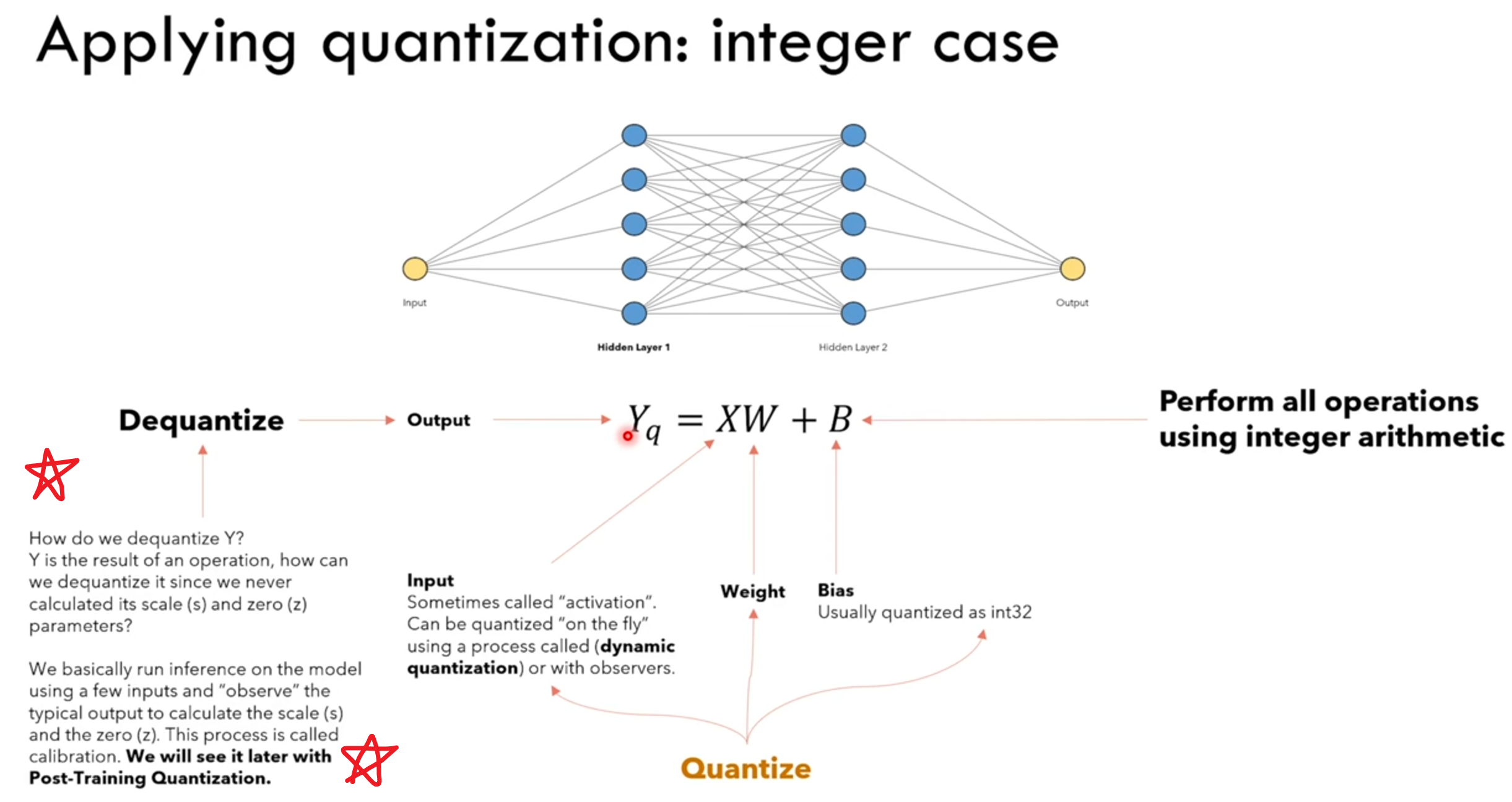
在我们量化时,量化操作可以应用于模型的输入、权重 和 激活(即神经元输出值)上。
但我们发现,对于激活值,我们执行反量化时,并不知道这些激活值对应的浮点数矩阵的最大值和最小值,即我们执行非对称或对称量化里面的 𝛼, β 参数,所以我们拿到一个模型时,最多只能对它的权重W和输入X做量化,对于激活值Y的反量化,我们需要一组小的calibration set数据来初步计算对于Y的S和Z参数。
不熟悉非对称或对称量化的朋友可以康康这篇:《模型量化(一)—— 非对称量化、对称量化(全代码)》
PTQ流程:
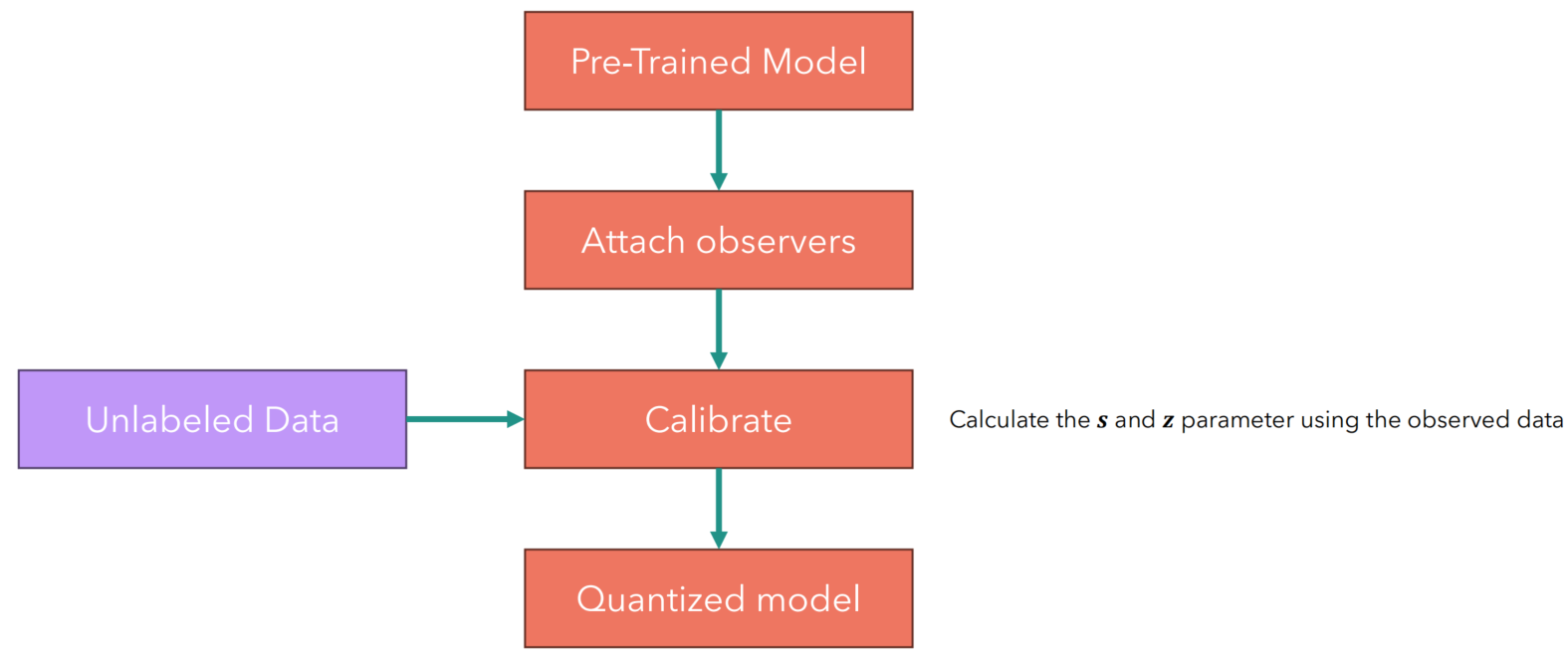
Observer,顾名思义就是模型在正常inference的时候会被记录下正常的浮点激活值,用来算激活值对应的S和Z参数。
Calibrate后模型的W和Y都有对应的S和Z了,模型名义上量化完成。浮点的输入X也能off-line地实时算它对应的S和Z。
压缩模型:原本所有的W都是浮点数存储,比如float32,现在转换为int8存储,模型尺寸减了大概4倍;再额外存一些神经元或网络层的S和Z参数(取决于量化的粗粒度),相对于W来说占内存很小(如果是很细粒度的量化可能这部分也得好好考虑,量化的粒度分为权重级量化、层级量化、通道级量化等)。
加速模型:主要的收益是使得模型中占大头的 W * X 操作变成了整型相乘,功耗和时延最低(浮点数相乘时功耗和时延最大)。3 * 100 * 100 * 10的全连接网络中,有213个神经元,但是有 3 * 100 * 100 * 10 = 300M个参数!这还是忽略了bias。量化相当于就是让这 300M 次乘法更轻量。而相对的 overhead 就是对开头的3 + 100 + 100 = 203个中间输入进行一下量化 和 对 100 + 100 + 10 = 210个激活值进行一下反量化,这部分开销随着网络层数与参数的增加几乎可以忽略不计。
一些专门的深度学习加速器和现代CPU/GPU提供了对低位宽整数(如int8)的优化支持,用这些硬件后可以更加体现模型量化的优势。
量化会带来一定的量化误差,即模型精度会受影响,这肯定的,但按经验来说几乎没什么影响,不要压到int4或int2这么极限就行。
全代码
预训练模型
import torch import torchvision.datasets as datasets import torchvision.transforms as transforms import torch.nn as nn import matplotlib.pyplot as plt from tqdm import tqdm from pathlib import Path import os # Make torch deterministic _ = torch.manual_seed(0) transform = transforms.Compose([transforms.ToTensor(), transforms.Normalize((0.1307,), (0.3081,))]) # Load the MNIST dataset mnist_trainset = datasets.MNIST(root='./data', train=True, download=True, transform=transform) # Create a dataloader for the training train_loader = torch.utils.data.DataLoader(mnist_trainset, batch_size=10, shuffle=True) # Load the MNIST test set mnist_testset = datasets.MNIST(root='./data', train=False, download=True, transform=transform) test_loader = torch.utils.data.DataLoader(mnist_testset, batch_size=10, shuffle=True) # Define the device device = "cpu" # Define the model class VerySimpleNet(nn.Module): def __init__(self, hidden_size_1=100, hidden_size_2=100): super(VerySimpleNet,self).__init__() self.linear1 = nn.Linear(28*28, hidden_size_1) self.linear2 = nn.Linear(hidden_size_1, hidden_size_2) self.linear3 = nn.Linear(hidden_size_2, 10) self.relu = nn.ReLU() def forward(self, img): x = img.view(-1, 28*28) x = self.relu(self.linear1(x)) x = self.relu(self.linear2(x)) x = self.linear3(x) return x net = VerySimpleNet().to(device) # Train the model def train(train_loader, net, epochs=5, total_iterations_limit=None): cross_el = nn.CrossEntropyLoss() optimizer = torch.optim.Adam(net.parameters(), lr=0.001) total_iterations = 0 for epoch in range(epochs): net.train() loss_sum = 0 num_iterations = 0 data_iterator = tqdm(train_loader, desc=f'Epoch {
     epoch+1}') if total_iterations_limit is not None: data_iterator.total = total_iterations_limit for data in data_iterator: num_iterations += 1 total_iterations += 1 x, y = data x = x.to(device) y = y.to(device) optimizer.zero_grad() output = net(x.view(-1, 28*28)) loss = cross_el(output, y) loss_sum += loss.item() avg_loss = loss_sum / num_iterations data_iterator.set_postfix(loss=avg_loss) loss.backward() optimizer.step() if total_iterations_limit is not None and total_iterations >= total_iterations_limit: return def print_size_of_model(model): torch.save(model.state_dict(), "temp_delme.p") print('Size (KB):', os.path.getsize("temp_delme.p")/1e3) os.remove('temp_delme.p') MODEL_FILENAME = 'simplenet_ptq.pt' if Path(MODEL_FILENAME).exists(): net.load_state_dict(torch.load(MODEL_FILENAME)) print('Loaded model from disk') else: train(train_loader, net, epochs=1) # Save the model to disk torch.save(net.state_dict(), MODEL_FILENAME) # Define the testing loop def test(model: nn.Module, total_iterations: int = None): correct = 0 total = 0 iterations = 0 model.eval() with torch.no_grad(): for data in tqdm(test_loader, desc='Testing'): x, y = data x = x.to(device) y = y.to(device) output = model(x.view(-1, 784)) for idx, i in enumerate(output): if torch.argmax(i) == y[idx]: correct +=1 total +=1 iterations += 1 if total_iterations is not None and iterations >= total_iterations: break print(f'Accuracy: {
     round(correct/total, 3)}') # Print weights and size of the model before quantization # Print the weights matrix of the model before quantization print('Weights before quantization') print(net.linear1.weight) print(net.linear1.weight.dtype) print('Size of the model before quantization') print_size_of_model(net) print(f'Accuracy of the model before quantization: ') test(net)
加入Observer
# Insert min-max observers in the model class QuantizedVerySimpleNet(nn.Module): def __init__(self, hidden_size_1=100, hidden_size_2=100): super(QuantizedVerySimpleNet,self).__init__() self.quant = torch.quantization.QuantStub() self.linear1 = nn.Linear(28*28, hidden_size_1) self.linear2 = nn.Linear(hidden_size_1, hidden_size_2) self.linear3 = nn.Linear(hidden_size_2, 10) self.relu = nn.ReLU() self.dequant = torch.quantization.DeQuantStub() def forward(self, img): x = img.view(-1, 28*28) x = self.quant(x) x = self.relu(self.linear1(x)) x = self.relu(self.linear2(x)) x = self.linear3(x) x = self.dequant(x) return x net_quantized = QuantizedVerySimpleNet().to(device) # Copy weights from unquantized model net_quantized.load_state_dict(net.state_dict()) net_quantized.eval() net_quantized.qconfig = torch.ao.quantization.default_qconfig net_quantized = torch.ao.quantization.prepare(net_quantized) # Insert observers net_quantized 校准模型
#用测试集再跑一次装了observer的模型 test(net_quantized) print(f'Check statistics of the various layers') net_quantized 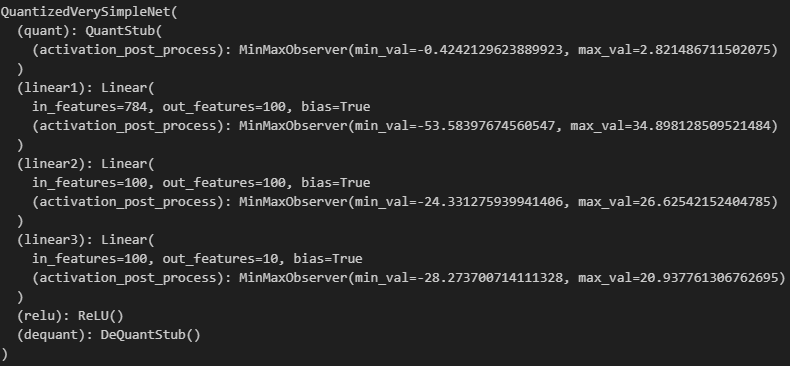
这时看到激活层的 𝛼, β 都有了,good!
量化模型
# Quantize the model using the statistics collected net_quantized = torch.ao.quantization.convert(net_quantized) print(f'Check statistics of the various layers') net_quantized 
# Print the weights matrix of the model after quantization print('Weights after quantization') print(torch.int_repr(net_quantized.linear1.weight())) # Compare the dequantized weights and the original weights print('Original weights: ') print(net.linear1.weight) print('') print(f'Dequantized weights: ') print(torch.dequantize(net_quantized.linear1.weight())) print('') # Print size and accuracy of the quantized model print('Size of the model after quantization') print_size_of_model(net_quantized) print('Testing the model after quantization') test(net_quantized) 免责声明:本站所有文章内容,图片,视频等均是来源于用户投稿和互联网及文摘转载整编而成,不代表本站观点,不承担相关法律责任。其著作权各归其原作者或其出版社所有。如发现本站有涉嫌抄袭侵权/违法违规的内容,侵犯到您的权益,请在线联系站长,一经查实,本站将立刻删除。 本文来自网络,若有侵权,请联系删除,如若转载,请注明出处:https://haidsoft.com/112907.html