
大家好,欢迎来到IT知识分享网。
简介
上篇文章 写给小白的 ROC 曲线详解 介绍了 ROC 曲线。本文介绍 AUC。AUC 的全名为Area Under the ROC Curve,即 ROC 曲线下的面积,最大为 1。
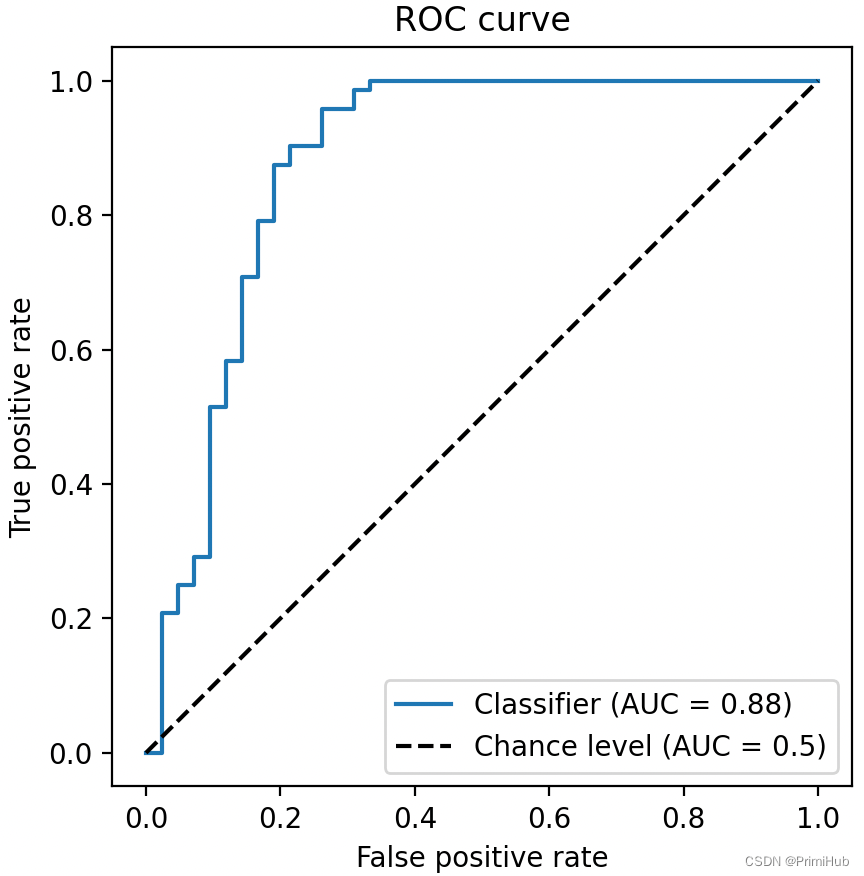
根据 ROC 和 AUC 的关系,我们可以得到如下结论
- ROC 曲线接近左上角 —> AUC 接近 1:模型预测准确率很高
- ROC 曲线略高于基准线 —> AUC 略大于 0.5:模型预测准确率一般
- ROC 低于基准线 —> AUC 小于 0.5:模型未达到最低标准,无法使用
二分类 AUC
由 AUC 名称可知,可以先计算 ROC 曲线,得到 TPR 和 FPR 的坐标后再分段计算面积即可得到 AUC
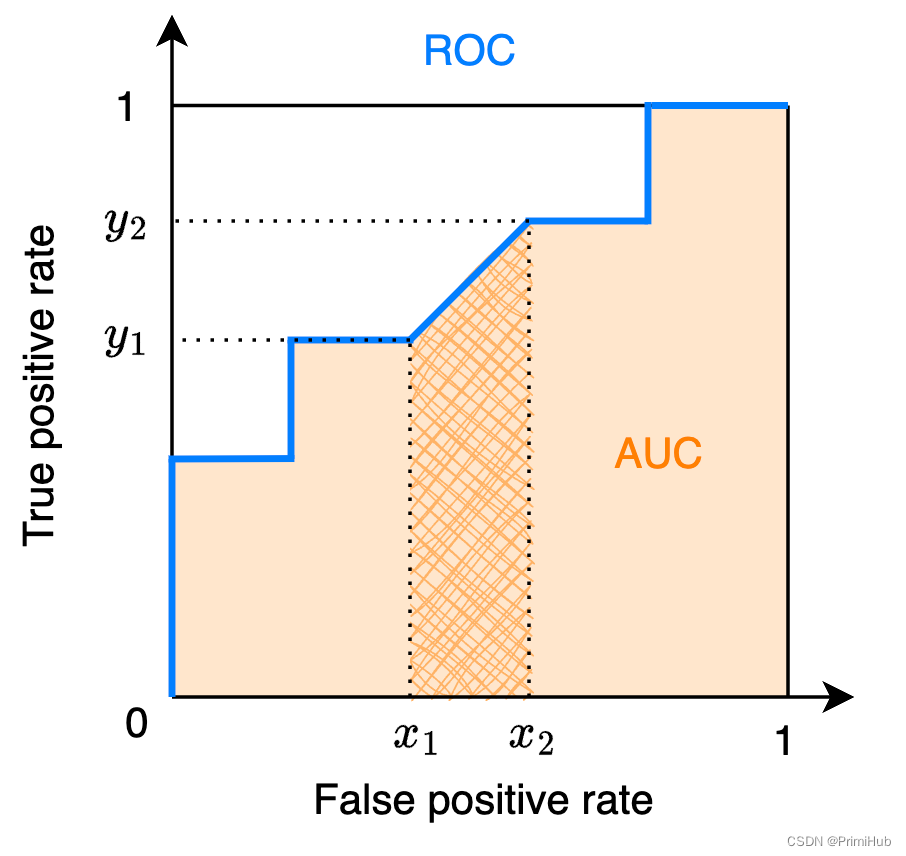
下面是对应的 Python 代码
def auc_from_roc(fpr, tpr): """ 计算ROC面积 fpr: 从小到大排序的fpr坐标 tpr: 从小到大排序的tpr坐标 """ area = 0 for i in range(len(fpr) - 1): area += trapezoid_area(fpr[i], fpr[i + 1], tpr[i], tpr[i + 1]) return area def trapezoid_area(x1, x2, y1, y2): """ 计算梯形面积 x1, x2: 横坐标 (x1 <= x2) y1, y2: 纵坐标 (y1 <= y2) """ base = x2 - x1 height_avg = (y1 + y2) / 2 return base * height_avg 也可以直接从真实标签和模型预测分数中计算 ROC,算法的时间复杂度为 O ( n log n ) O(n\log n) O(nlogn),参考文献 1 中的算法 2
# import numpy as np def auc_binary(y_true, y_score, pos_label): """ y_true:真实标签 y_score:模型预测分数 pos_label:正样本标签,如“1” """ num_positive_examples = (y_true == pos_label).sum() num_negtive_examples = len(y_true) - num_positive_examples tp, fp, tp_prev, fp_prev, area = 0, 0, 0, 0, 0 score = -np.inf for i in np.flip(np.argsort(y_score)): if y_score[i] != score: area += trapezoid_area(fp_prev, fp, tp_prev, tp) score = y_score[i] fp_prev = fp tp_prev = tp if y_true[i] == pos_label: tp += 1 else: fp += 1 area += trapezoid_area(fp_prev, fp, tp_prev, tp) area /= num_positive_examples * num_negtive_examples return area 多分类 AUC
现在考虑多分类的情况,假设类别数为 C C C。
一种想法是将某一类别设为正样本类别,其余类别设为负样本类别,然后计算二分类下的 AUC。这种方法叫做一对多,即 One-Vs-Rest (OVR)。可以得到 C C C个二分类的 AUC,然后计算平均数得到多分类的 AUC。
另一种想法是将某一类别设为正样本类别,另外一个类别(非自身)设为负样本类别计算二分类的 AUC。这种方法叫做一对一,即 One-Vs-One (OVO)。可以得到 C ( C − 1 ) C(C-1) C(C−1)个二分类的 AUC,然后计算平均数。
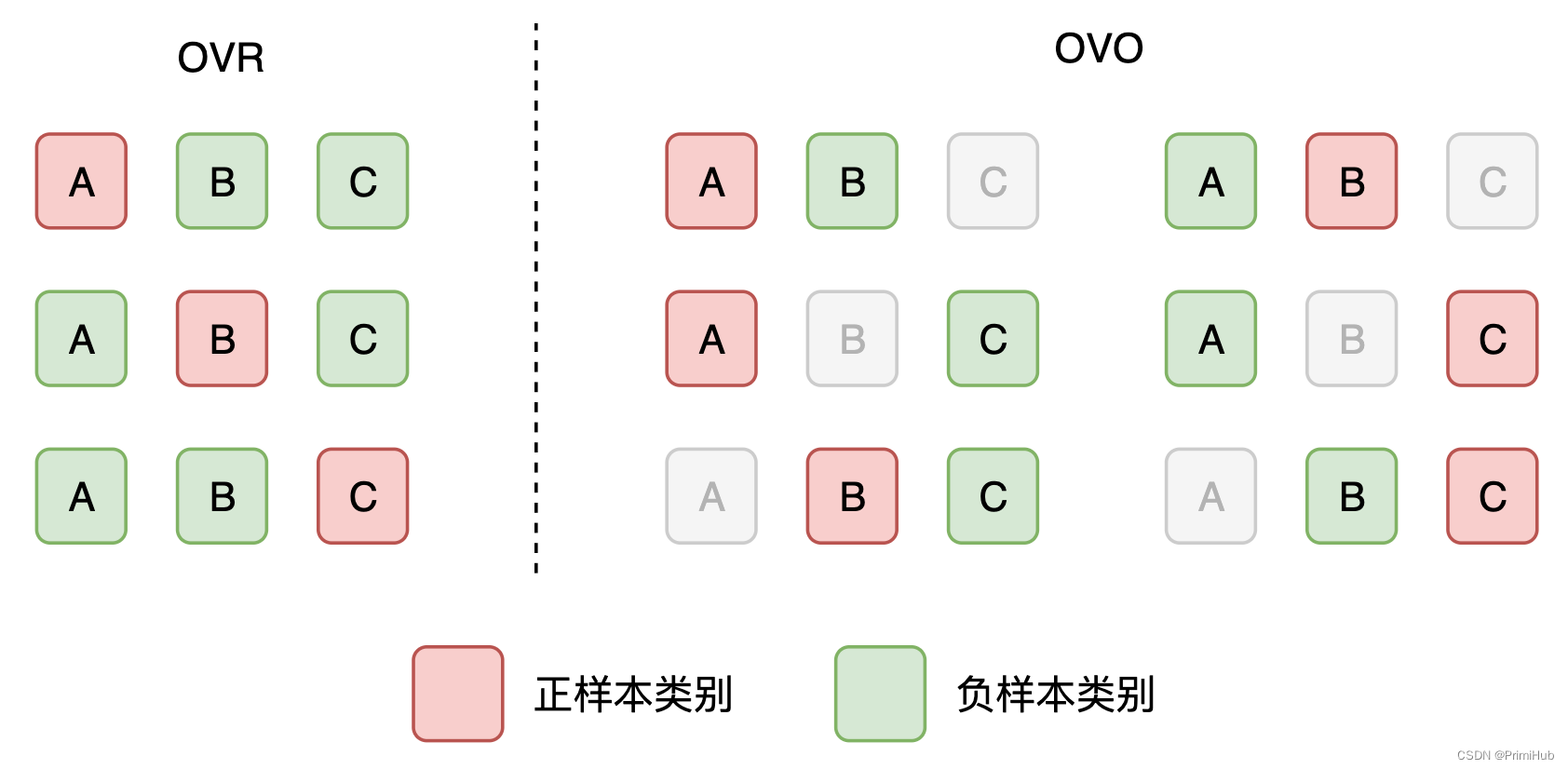
当计算平均数时,可以考虑算数平均数(称为 macro),或者加权平均数(称为 weighted)。其中,加权为各类别的样本所占比例。因此,两两组合可以的得到四种计算多分类 AUC 的方法。值得一提的是,知名机器学习库 scikit-learn 的 roc_auc_score 函数 包含了上述四种方法。
- 一对多 + 算数平均数(OVR + macro)
- 一对多 + 加权平均数(OVR + weighted)
- 一对一 + 算数平均数(OVO + macro)
- 一对一 + 加权平均数(OVO + weighted)
一对多 + 算数平均数
多分类 AUC 的计算公式为
AUC total = 1 C ∑ c i ∈ C AUC ( c i ) \text{AUC}_\text{total}=\frac{1}{C}\sum_{c_i\in C}\text{AUC}(c_i) AUCtotal=C1ci∈C∑AUC(ci)
其中 AUC ( c i ) \text{AUC}(c_i) AUC(ci)是将类别 c i c_i ci作为正样本类别(剩余作为负样本类别),计算的二分类 AUC。
# sklearn.metrics.roc_auc_score(y_true, y_score, average='macro', multi_class='ovr') def auc_ovr_macro(y_true, y_score): auc = 0 C = max(y_true) + 1 for i in range(C): auc += auc_binary(y_true, y_score[:, i], pos_label=i) return auc / C 一对多 + 加权平均数
多分类 AUC 的计算公式为
AUC total = ∑ c i ∈ C AUC ( c i ) p ( c i ) \text{AUC}_\text{total}=\sum_{c_i\in C}\text{AUC}(c_i)p(c_i) AUCtotal=ci∈C∑AUC(ci)p(ci)
其中,权重 p ( c i ) = ∑ I { y = c i } n p(c_i)=\frac{\sum\mathbb{I}\{y=c_i\}}{n} p(ci)=n∑I{
y=ci},即标签为 c i c_i ci的样本所占比例,权重之和为 1。
# sklearn.metrics.roc_auc_score(y_true, y_score, average='weighted', multi_class='ovr') def auc_ovr_weighted(y_true, y_score): auc = 0 C = max(y_true) + 1 n = len(y_true) for i in range(C): p = sum(y_true == i) / n auc += auc_binary(y_true, y_score[:, i], pos_label=i) * p return auc 一对一 + 算数平均数
多分类 AUC 的计算公式为
AUC total = 2 C ( C − 1 ) ∑ { c i , c j } ∈ C , c i < c j AUC ( c i , c j ) \text{AUC}_\text{total}=\frac{2}{C(C-1)}\sum_{\{c_i,c_j\}\in C,\ c_i<c_j}\text{AUC}(c_i,c_j) AUCtotal=C(C−1)2{
ci,cj}∈C, ci<cj∑AUC(ci,cj)
其中, AUC ( c i , c j ) = AUC ( c i | c j ) + AUC ( c j | c i ) 2 \text{AUC}(c_i,c_j)=\frac{\text{AUC}(c_i|c_j)+\text{AUC}(c_j|c_i )}{2} AUC(ci,cj)=2AUC(ci|cj)+AUC(cj|ci)。即将 c i c_i ci作为正样本类别、 c j c_j cj作为负样本类别计算二分类 AUC ( c i | c j ) \text{AUC}(c_i|c_j) AUC(ci|cj);然后将 c j c_j cj作为正样本类别、 c i c_i ci作为负样本类别计算二分类 AUC ( c j | c i ) \text{AUC}(c_j|c_i) AUC(cj|ci)。 AUC ( c i , c j ) \text{AUC}(c_i,c_j) AUC(ci,cj)为其计算的算数平均值。由于将 c i c_i ci和 c j c_j cj组合计算,共得到 C ( C − 1 ) / 2 C(C-1)/2 C(C−1)/2 个二分类 AUC。
# sklearn.metrics.roc_auc_score(y_true, y_score, average='macro', multi_class='ovo') def auc_ovo_macro(y_true, y_score): auc = 0 C = max(y_true) + 1 for i in range(C - 1): i_index = np.where(y_true == i)[0] for j in range(i + 1, C): j_index = np.where(y_true == j)[0] index = np.concatenate((i_index, j_index)) auc_i_j = auc_binary(y_true[index], y_score[index, i], pos_label=i) auc_j_i = auc_binary(y_true[index], y_score[index, j], pos_label=j) auc += (auc_i_j + auc_j_i) / 2 return auc * 2 / (C * (C - 1)) 一对一 + 加权平均数
多分类 AUC 的计算公式为
AUC total = ∑ { c i , c j } ∈ C , c i < c j AUC ( c i , c j ) p ( c i , c j ) \text{AUC}_\text{total}=\sum_{\{c_i,c_j\}\in C,\ c_i<c_j}\text{AUC}(c_i,c_j)p(c_i,c_j) AUCtotal={
ci,cj}∈C, ci<cj∑AUC(ci,cj)p(ci,cj)
其中,权重 p ( c i , c j ) = ∑ I { y = c i } + ∑ I { y = c j } ( C − 1 ) n p(c_i,c_j)=\frac{\sum\mathbb{I}\{y=c_i\}+\sum\mathbb{I}\{y=c_j\}}{(C-1)n} p(ci,cj)=(C−1)n∑I{
y=ci}+∑I{
y=cj},即标签为 c i c_i ci和 c j c_j cj的样本所占比例,分母中的系数 C − 1 C-1 C−1使得权重之和为 1。
# sklearn.metrics.roc_auc_score(y_true, y_score, average='weighted', multi_class='ovo') def auc_ovo_weighted(y_true, y_score): auc = 0 C = max(y_true) + 1 n = len(y_true) for i in range(C - 1): i_index = np.where(y_true == i)[0] for j in range(i + 1, C): j_index = np.where(y_true == j)[0] index = np.concatenate((i_index, j_index)) p = len(index) / n / (C - 1) auc_i_j = auc_binary(y_true[index], y_score[index, i], pos_label=i) auc_j_i = auc_binary(y_true[index], y_score[index, j], pos_label=j) auc += (auc_i_j + auc_j_i) / 2 * p return auc 参考文献
- Fawcett, Tom. “An introduction to ROC analysis.” Pattern recognition letters 27, no. 8 (2006): 861-874. https://www.researchgate.net/profile/Tom-Fawcett/publication/_Introduction_to_ROC_analysis/links/5ac7844ca6fdcc8bfc7fa47e/Introduction-to-ROC-analysis.pdf
- Hand, David J., and Robert J. Till. “A simple generalisation of the area under the ROC curve for multiple class classification problems.” Machine learning 45 (2001): 171-186. https://link.springer.com/content/pdf/10.1023/A:31.pdf
作者 PrimiHub-Kevin
免责声明:本站所有文章内容,图片,视频等均是来源于用户投稿和互联网及文摘转载整编而成,不代表本站观点,不承担相关法律责任。其著作权各归其原作者或其出版社所有。如发现本站有涉嫌抄袭侵权/违法违规的内容,侵犯到您的权益,请在线联系站长,一经查实,本站将立刻删除。 本文来自网络,若有侵权,请联系删除,如若转载,请注明出处:https://haidsoft.com/114751.html