
大家好,欢迎来到IT知识分享网。
Mybatis动态SQL
1 什么是动态SQL
2 动态SQL-if
<if>:用于判断条件是否成立。使用test属性进行条件判断,如果条件为true,则拼接SQL。
<if test="条件表达式"> 要拼接的sql语句 </if> 接下来,我们就通过<if>标签来改造之前条件查询的案例。
2.1 条件查询
示例:把SQL语句改造为动态SQL方式
- 原有的SQL语句
<select id="list" resultType="com.itheima.pojo.Emp"> select * from emp where name like concat('%',#{name},'%') and gender = #{gender} and entrydate between #{begin} and #{end} order by update_time desc </select> - 动态SQL语句
<select id="list" resultType="com.itheima.pojo.Emp"> select * from emp where <if test="name != null"> name like concat('%',#{name},'%') </if> <if test="gender != null"> and gender = #{gender} </if> <if test="begin != null and end != null"> and entrydate between #{begin} and #{end} </if> order by update_time desc </select> 测试方法:
@Test public void testList(){ //性别数据为null、开始时间和结束时间也为null List<Emp> list = empMapper.list("张", null, null, null); for(Emp emp : list){ System.out.println(emp); } } @Test public void testList(){ //姓名为null List<Emp> list = empMapper.list(null, (short)1, null, null); for(Emp emp : list){ System.out.println(emp); } } @Test public void testList(){ //传递的数据全部为null List<Emp> list = empMapper.list(null, null, null, null); for(Emp emp : list){ System.out.println(emp); } } <where>只会在子元素有内容的情况下才插入where子句,而且会自动去除子句的开头的AND或OR
<select id="list" resultType="com.itheima.pojo.Emp"> select * from emp <where> <!-- if做为where标签的子元素 --> <if test="name != null"> and name like concat('%',#{name},'%') </if> <if test="gender != null"> and gender = #{gender} </if> <if test="begin != null and end != null"> and entrydate between #{begin} and #{end} </if> </where> order by update_time desc </select> 测试方法:
@Test public void testList(){ //只有性别 List<Emp> list = empMapper.list(null, (short)1, null, null); for(Emp emp : list){ System.out.println(emp); } } 2.2 更新员工
案例:完善更新员工功能,修改为动态更新员工数据信息
- 动态更新员工信息,如果更新时传递有值,则更新;如果更新时没有传递值,则不更新
- 解决方案:动态SQL
修改Mapper接口:
@Mapper public interface EmpMapper { //删除@Update注解编写的SQL语句 //update操作的SQL语句编写在Mapper映射文件中 public void update(Emp emp); } 修改Mapper映射文件:
<?xml version="1.0" encoding="UTF-8" ?> <!DOCTYPE mapper PUBLIC "-//mybatis.org//DTD Mapper 3.0//EN" "https://mybatis.org/dtd/mybatis-3-mapper.dtd"> <mapper namespace="com.itheima.mapper.EmpMapper"> <!--更新操作--> <update id="update"> update emp set <if test="username != null"> username=#{username}, </if> <if test="name != null"> name=#{name}, </if> <if test="gender != null"> gender=#{gender}, </if> <if test="image != null"> image=#{image}, </if> <if test="job != null"> job=#{job}, </if> <if test="entrydate != null"> entrydate=#{entrydate}, </if> <if test="deptId != null"> dept_id=#{deptId}, </if> <if test="updateTime != null"> update_time=#{updateTime} </if> where id=#{id} </update> </mapper> 测试方法:
@Test public void testUpdate2(){ //要修改的员工信息 Emp emp = new Emp(); emp.setId(20); emp.setUsername("Tom111"); emp.setName("汤姆111"); emp.setUpdateTime(LocalDateTime.now()); //调用方法,修改员工数据 empMapper.update(emp); } @Test public void testUpdate2(){ //要修改的员工信息 Emp emp = new Emp(); emp.setId(20); emp.setUsername("Tom222"); //调用方法,修改员工数据 empMapper.update(emp); } <set>:动态的在SQL语句中插入set关键字,并会删掉额外的逗号。(用于update语句中)
<?xml version="1.0" encoding="UTF-8" ?> <!DOCTYPE mapper PUBLIC "-//mybatis.org//DTD Mapper 3.0//EN" "https://mybatis.org/dtd/mybatis-3-mapper.dtd"> <mapper namespace="com.itheima.mapper.EmpMapper"> <!--更新操作--> <update id="update"> update emp <!-- 使用set标签,代替update语句中的set关键字 --> <set> <if test="username != null"> username=#{username}, </if> <if test="name != null"> name=#{name}, </if> <if test="gender != null"> gender=#{gender}, </if> <if test="image != null"> image=#{image}, </if> <if test="job != null"> job=#{job}, </if> <if test="entrydate != null"> entrydate=#{entrydate}, </if> <if test="deptId != null"> dept_id=#{deptId}, </if> <if test="updateTime != null"> update_time=#{updateTime} </if> </set> where id=#{id} </update> </mapper> <if>- 用于判断条件是否成立,如果条件为true,则拼接SQL
形式:
- …
<where>- where元素只会在子元素有内容的情况下才插入where子句,而且会自动去除子句的开头的AND或OR
<set>- 动态地在行首插入 SET 关键字,并会删掉额外的逗号。(用在update语句中)
3 动态SQL-foreach
@Mapper public interface EmpMapper { //批量删除 public void deleteByIds(List<Integer> ids); } XML映射文件:
- 使用
<foreach>遍历deleteByIds方法中传递的参数ids集合
<foreach collection="集合名称" item="集合遍历出来的元素/项" separator="每一次遍历使用的分隔符" open="遍历开始前拼接的片段" close="遍历结束后拼接的片段"> </foreach> <?xml version="1.0" encoding="UTF-8" ?> <!DOCTYPE mapper PUBLIC "-//mybatis.org//DTD Mapper 3.0//EN" "https://mybatis.org/dtd/mybatis-3-mapper.dtd"> <mapper namespace="com.itheima.mapper.EmpMapper"> <!--删除操作--> <delete id="deleteByIds"> delete from emp where id in <foreach collection="ids" item="id" separator="," open="(" close=")"> #{id} </foreach> </delete> </mapper> 执行的SQL语句:
4 动态SQL-sql&include
问题分析:
- 在xml映射文件中配置的SQL,有时可能会存在很多重复的片段,此时就会存在很多冗余的代码
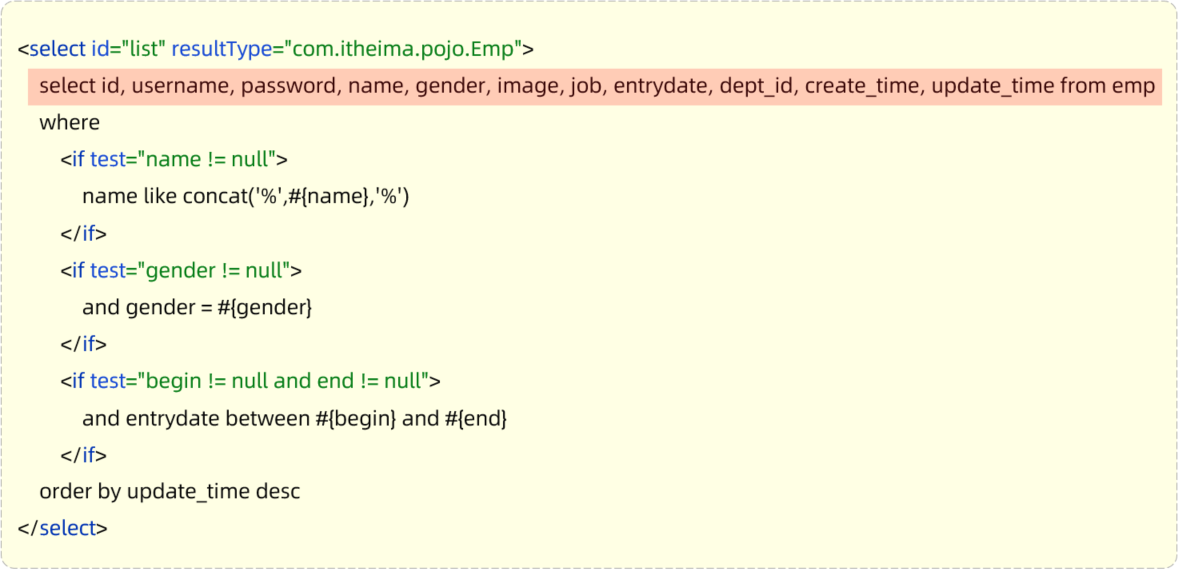

我们可以对重复的代码片段进行抽取,将其通过<sql>标签封装到一个SQL片段,然后再通过<include>标签进行引用。
<sql>:定义可重用的SQL片段<include>:通过属性refid,指定包含的SQL片段
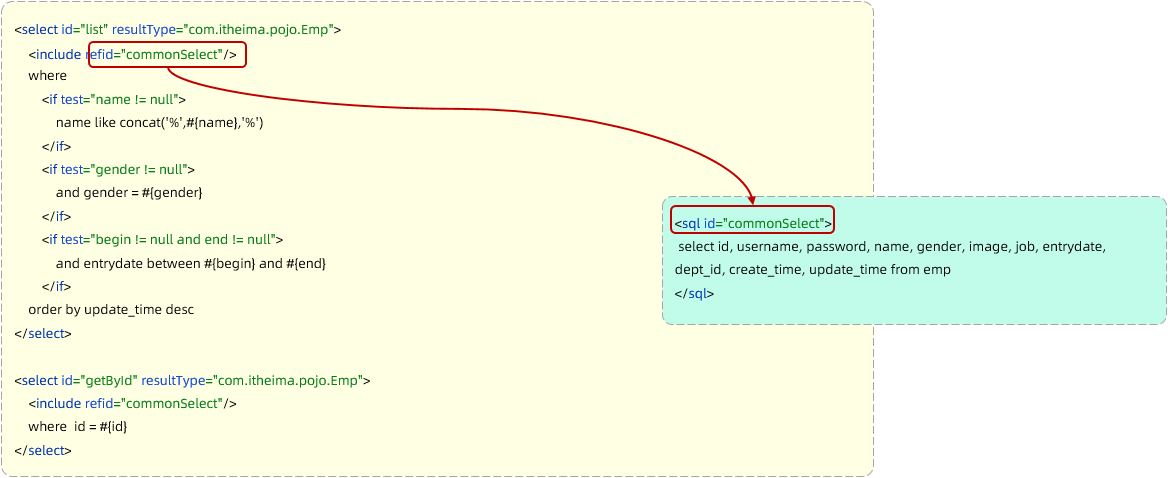
SQL片段: 抽取重复的代码
<sql id="commonSelect"> select id, username, password, name, gender, image, job, entrydate, dept_id, create_time, update_time from emp </sql> 然后通过<include> 标签在原来抽取的地方进行引用。操作如下:
<select id="list" resultType="com.itheima.pojo.Emp"> <include refid="commonSelect"/> <where> <if test="name != null"> name like concat('%',#{name},'%') </if> <if test="gender != null"> and gender = #{gender} </if> <if test="begin != null and end != null"> and entrydate between #{begin} and #{end} </if> </where> order by update_time desc </select> 免责声明:本站所有文章内容,图片,视频等均是来源于用户投稿和互联网及文摘转载整编而成,不代表本站观点,不承担相关法律责任。其著作权各归其原作者或其出版社所有。如发现本站有涉嫌抄袭侵权/违法违规的内容,侵犯到您的权益,请在线联系站长,一经查实,本站将立刻删除。 本文来自网络,若有侵权,请联系删除,如若转载,请注明出处:https://haidsoft.com/110414.html